Visiting Machu Picchu is one of those once-in-a-lifetime experiences, but buying the right ticket can be confusing, especially if you’ve never had to deal with Peru’s official Machu Picchu ticketing system before.
As a local resident who helps travelers visit Machu Picchu every week, I can tell you this: most of the problems people face (sold-out tickets, incorrect circuits, unsuitable entry times) are because they don’t fully understand how the ticket system works.
In this guide, I will explain exactly how Machu Picchu tickets work in 2026, the official prices, the different types of tickets, and practical tips that tour companies use to avoid common mistakes.
Official Machu Picchu Ticket Prices (2026)
Ticket prices are set by the Peruvian Ministry of Culture and are the same whether purchased online or in person.
The following are the official prices for foreign visitors (approximate values in US dollars may vary depending on the exchange rate):
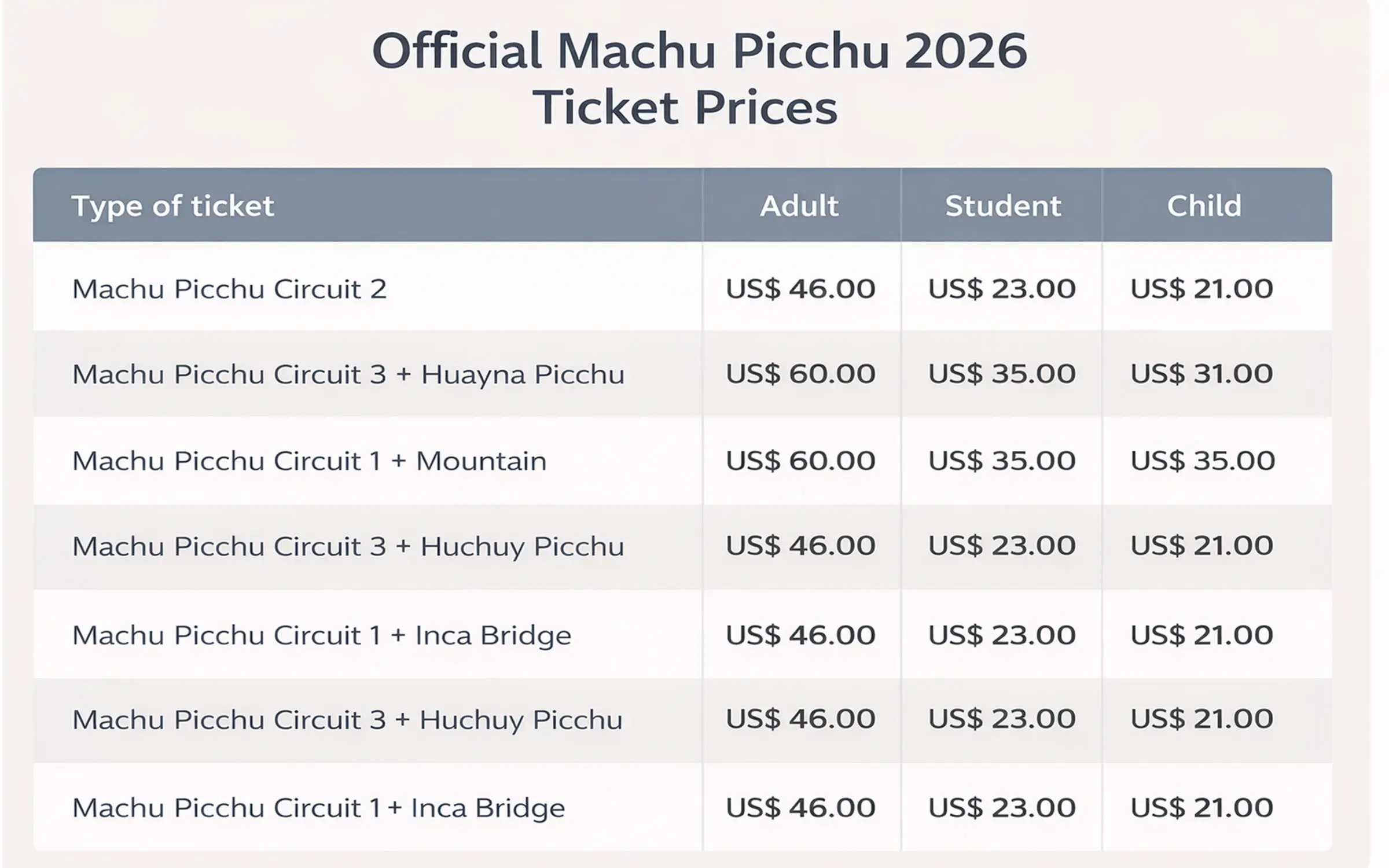
Machu Picchu Ticket Prices 2026
Overview: Machu Picchu Circuits Explained (2026 System)
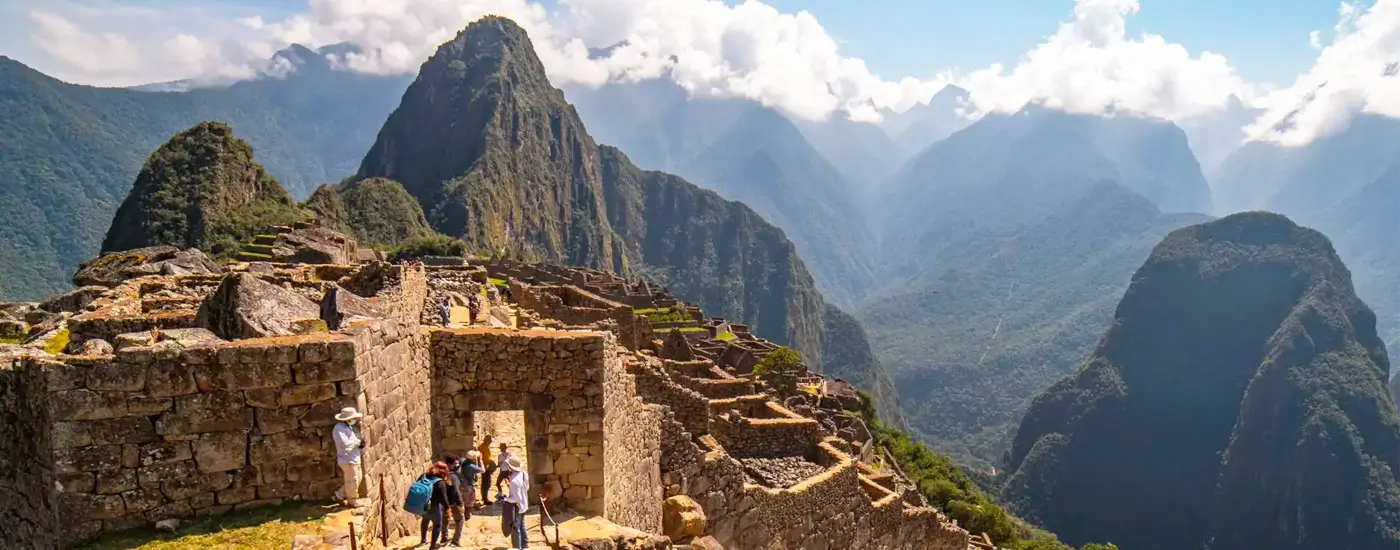
Machu Picchu no longer allows visitors to walk freely inside the site: visitors must enter via designated circuits that direct traffic, protect the ruins, and manage visitor numbers. Each circuit provides access to different parts of the citadel and is linked to specific entrance paths and experiences.
Circuit 1: Panoramic Circuit
Circuit 1 is often referred to as the Panoramic Circuit. It focuses on the upper part of Machu Picchu, including the main viewpoints and the guardhouse, famous for the iconic postcard photos of the sanctuary.
Variations of Circuit 1
1-A – Machu Picchu Mountain:
Includes a hike to Machu Picchu Mountain (a shorter hike with excellent views) and the upper terraces. The entire visit can take up to 6 hours due to the mountain hike.
1-B – Upper Terraces Only:
Ideal for taking photos and enjoying classic views, but does not allow you to explore the entire citadel. Duration: 2.5 hours.
1-C – Sun Gate (Inti Punku) (seasonal):
Combines the upper terraces with a hike to the Sun Gate along a short section of the Inca Trail. The views are beautiful, but not as spectacular as those from the mountain hikes.
1-D – Puente Inca (Inca Bridge) (seasonal):
A shorter hike from the upper terraces to Puente Inca, a panoramic viewpoint and archaeological feature.
Ideal for: photography enthusiasts, short visits, people who want to enjoy the iconic views without exploring the citadel in depth.
perugrandtravel.com
Circuit 2 — Classic Circuit (the most popular)
Circuit 2 is considered by many to be the best route overall, the most traditional and complete way to visit Machu Picchu. It combines parts of Circuit 1 with an additional tour of the most significant areas of the citadel.
Variations of Circuit 2
2-A – Designed route:
It starts at the upper platform and covers the urban sector of Machu Picchu: the Sacred Plaza, the Temple of the Sun, the Temple of the Three Windows, the dwellings, and much more. It offers a complete archaeological experience and the classic viewpoint.
2-B – Lower terrace route:
Similar to 2-A, but starts from a terrace just below the main viewpoint. It also allows you to take excellent photos and explore most of the important temples and plazas, with slightly different perspectives.
Ideal for: First-time visitors and anyone who wants to enjoy the essential Machu Picchu experience, including both the iconic views and the most significant ruins.
Circuit 3 — Machu Picchu Royalty
Circuit 3 delves deeper into the historical and ceremonial heart of Machu Picchu. It includes agricultural terraces and key Inca structures, and is often combined with mountain hikes or special extensions.
Common variants of Circuit 3
3-A – Huayna Picchu Mountain:
Includes a walk through the central and lower sections of the citadel, as well as the climb up Huayna Picchu, the iconic peak that dominates Machu Picchu. The overall experience is longer and more strenuous than other circuits.
3-B – Elaborate Route (main royal road):
Focuses on the terraces and important urban structures such as the Temple of the Sun, the Main Royal House, the Temple of the Condor, etc. It is ideal if Circuit 2 is complete, as it covers most of the main areas.
3-C – The Great Cave (high season only):
Extends 3-B with a hike to the Great Cave behind Huayna Picchu. The trail can be narrow and a bit steep, so it is more suitable for experienced hikers.
3-D – Huchuy Picchu Mountain (high season only):
A hike up a smaller mountain (about 30-45 minutes), ideal for enjoying panoramic views without the difficulty of Huayna Picchu.
Ideal for: adventurous travelers, people who want a deeper archaeological experience, or those who missed Circuit 2 but still want to explore most of the site.
How to By Tickets for Machu Picchu (Official and Secure Method)
Option 1: Official Government Website
The only official ticket sales platform is managed by the Ministry of Culture.
- Tickets are sold in limited quantities.
- During high season (May-September), they sell out quickly.
- The website may run slowly or crash (this is normal here).
Local tip: Try to book early in the morning (Peruvian time). The system usually works better then.
Option 2: Buy tickets in Aguas Calientes (last-minute option)
Yes, it is still possible, but it is risky.
- A limited number of tickets are issued each day.
- You must line up early.
- There is no guarantee that you will be able to choose your preferred circuit.
This option works best during the low season (January-March).
Option 3: Through a tour operator.
It’s not cheaper, but it’s less stressful, especially if tickets are almost sold out.
Ideal for:
- Short trips.
- Travelers during peak season.
- People who want transportation + guide included.
When Do Machu Picchu Tickets Sell Out?
When do tickets for Machu Picchu sell out?
Based on local experience:
- Huayna Picchu: 2-3 months in advance.
- Classic circuit (high season): 3-6 weeks in advance.
- Low season: often available until the last minute.
The best months to book in advance: May, June, July, and August (dry season and busiest).
Entry Times: Morning vs Afternoon (Local Advice)
Early morning (6:00-7:00):
More people, possible fog, but magical atmosphere.
Mid-morning (8:00-10:00):
Best balance between light and visibility.
Afternoon (after 12:00):
Fewer people, warmer weather, and clearer skies in the dry season.
As a local guide often recommend entering at 8:00 or 9:00 in the morning.
What If Tickets Are Sold Out? (Realistic Solutions)
If everything seems to be sold out:
- Check availability daily (sometimes tickets are released in small batches).
- Look for alternative tours.
- If you’re flexible, try to stay in Aguas Calientes to get a ticket for next day.
- Consider booking a guided tour as a backup plan.
Don’t trust resellers offering “guaranteed tickets” at unrealistic prices.
Total Cost to Visit Machu Picchu (Real Budget Breakdown)
The total cost of visiting Machu Picchu can vary significantly depending on the season of travel, the type of train you choose, and whether you organize the trip independently or rely on the logistics and services provided by travel agencies. As a local resident, this is something I see every day: two travelers visiting the site on the same date can end up paying very different amounts depending on the time of year, the train category, and how they plan their visit.
The entrance fee to Machu Picchu is only part of the total budget. Below is a realistic breakdown of what most travelers typically spend:
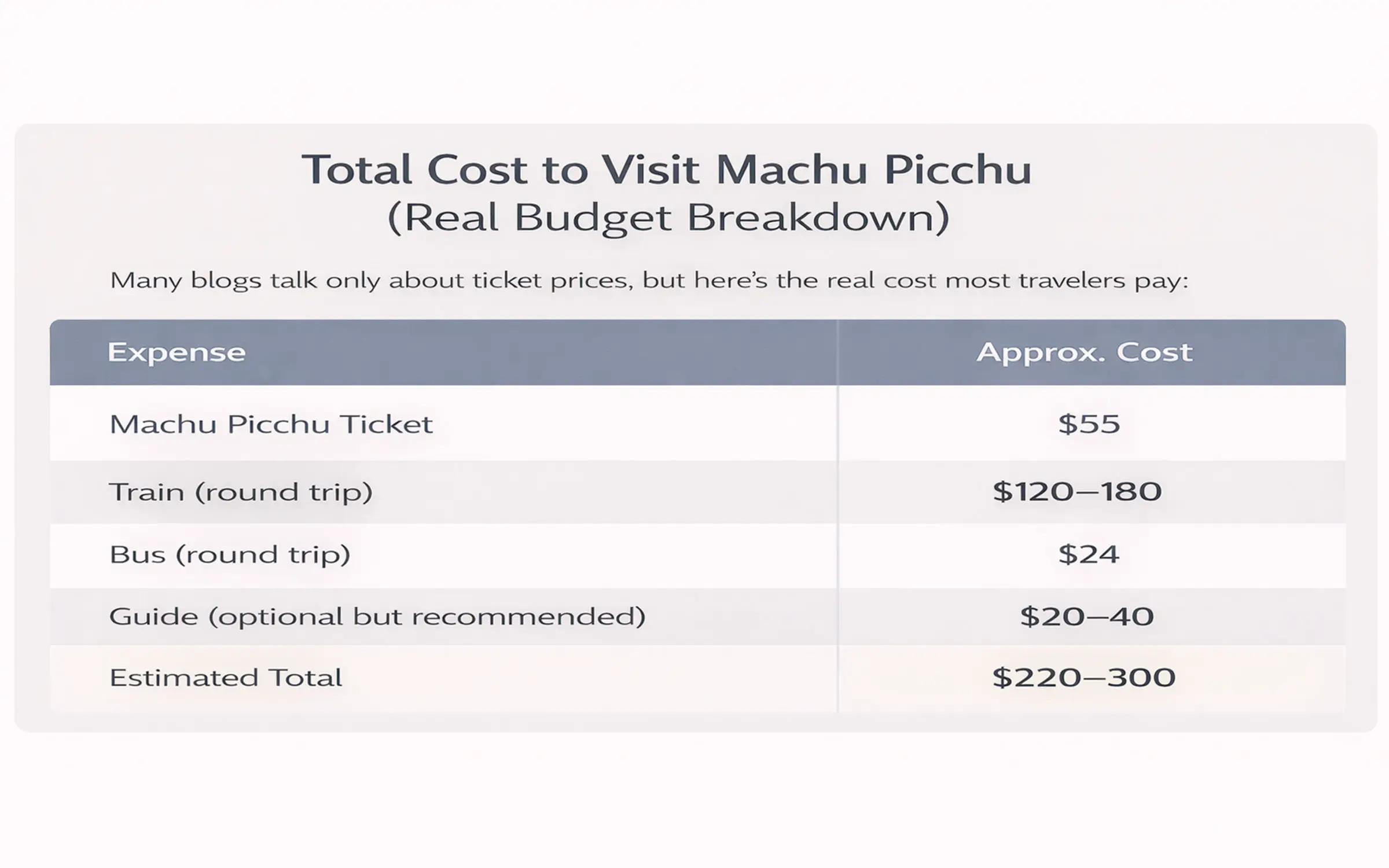
Total Cost to visit Machu Picchu
Official Websites to Buy Tickets to Machu Picchu:
To make planning easier, it is important to use official and reliable sources. As a local resident, I always recommend checking these websites first to avoid confusion, outdated information, or unofficial resellers.
Ministry of Culture: official tickets to Machu Picchu
This is the only official government platform where tickets to Machu Picchu are sold managed by the Peruvian Ministry of Culture.
Here i provide the link: https://tuboleto.cultura.pe/
It shows real-time availability by circuit and entry time.
Prices are official and fixed.
This is the best place to check ticket availability before making any other plans.
Important Local Advice
- There are no ticket offices at the entrance to Machu Picchu.
- Tickets for Machu Picchu are non-refundable and cannot be exchanged.
- Avoid websites offering “last-minute guaranteed tickets” at inflated prices.
Using official sources will help ensure a smooth visit and avoid unnecessary stress once you arrive in Cusco.